
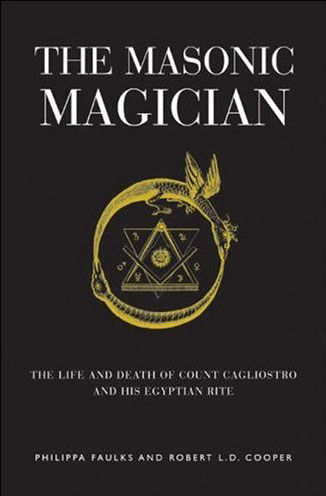
The Masonic Magician: The Life and Death of Count Cagliostro and His Egyptian Rite
“The Masonic Magician” tells Cagliostro’s extraordinary story, complete with the first English translation of his “Egyptian Rite of Freemasonry” ever published. The authors examine the case made against him, that he was an impostor as well as a heretic, and find that the Roman Church, and history itself, have done him a terrible injustice. This engaging account, drawing on remarkable new documentary evidence, shows that the man condemned was a genuine visionary and true champion of Freemasonry. His teachings have much to reveal to us today not just of the secrets of the movement, but of the mysterious hostility it continues to attract.
The chapter headings are:
PART ONE The Life and Times of Cagliostro
1. The Early Years
2. The Masonic Magician
3. The Final Years
4. The Man, the Myths, the Legend
PART TWO The Origins and History of Freemasonry 101
5. The Philosopher's Stonemasons
6. The Making of Masonic History
7. A Legacy of Persecution
PART THREE Cagliostro's Egyptian Freemasonry
8. Egyptian Freemasonry
9. The Ritual of Egyptian Freemasonry
10. A Commentary on Cagliostro's Egyptian Ritual
Together with: Conclusion, Endnotes, Appendices, Glossary, Bibliography and an Index
BOOK REVIEW:
Cooper is the curator of the Grand Lodge of Scotland's library and museum — the man who found the manuscript this book exists for.
The cover emblem is the ouroboros — the serpent devouring its own tail — coiled around a triangle containing a hexagram and a rose. That's the Egyptian Rite's own seal, and it's the perfect image for the man: a circle that eats itself, a life that devoured its own legend.
The Man
Count Alessandro Cagliostro was born Giuseppe Balsamo in Palermo in 1743. He left Sicily as a young man, traveled the Mediterranean, and reappeared in Europe as a healer, alchemist, and Freemason. He inspired wild devotion and savage ridicule — Dumas wrote novels about him, Goethe wrote a drama, Mozart's Magic Flute is widely read as a veiled portrait of him and his Egyptian Rite.
His Egyptian Rite of Freemasonry admitted women — his wife Lorenza, known as Serafina, led the female lodges — and promised magical powers, including immortality. That promise made him dangerous enemies.
The Fall
In 1789, in Rome, the Inquisition arrested him. He was condemned to death for heresy. Pope Pius VI commuted the sentence to life imprisonment. He died in 1795 in the fortress of San Leo, in a cell that is still open to the public today — visitors leave a single red rose.
The Book's Contribution
The core of this book is the first English translation of the Egyptian Rite ever published, drawn from a manuscript in the Grand Lodge of Scotland's archives. The authors argue the Church and history did him a terrible injustice — that the man condemned as an impostor was a genuine visionary and a true champion of Freemasonry.
The question worth sitting with: was Cagliostro a fraud who believed his own story, or a genuine mystic destroyed by an institution that couldn't tolerate what he claimed? The book argues the second. The manuscript argues it too.
By an anonymous author writing on: "On the Wizard's Path.